
In a diversified portfolio, something you own will almost always look disappointing compared with something else.
Maybe U.S. stocks are having a great year while international investments lag. Maybe technology companies are climbing while bonds look boring. Or changes in oil prices, interest rates, and geopolitical risk suddenly reshuffle which parts of the market investors favor. When that happens, it is natural to look at the weakest part of your portfolio and wonder, Why do I still own this?
That question feels especially relevant in the current environment. As of the time of publication, investors have been digesting elevated oil prices, higher Treasury yields, renewed inflation concerns, and volatility in parts of the stock market. The same headlines are not affecting every investment in the same way. That can be uncomfortable, but it also gets to the heart of why we diversify in the first place.
Sometimes a disappointing investment really does deserve another look. Portfolios should change as your goals and financial plan change. But underperformance alone does not necessarily mean an investment no longer belongs. In a diversified portfolio, the answer may simply be that it is not supposed to behave exactly like everything else you own.
Diversification Is Really About Being Different
Most of us know diversification through the familiar advice not to put all our eggs in one basket. But there is a difference between owning many investments and owning investments that actually diversify one another. Thirty different stocks may sound diversified, but if they are all exposed to the same industry, country, or economic forces, many of the same risks remain.
A broader portfolio combines investments with different drivers of return. There is a statistical term for how closely investments tend to move together: correlation. You do not need the math to understand the idea. If everything you own reacts almost identically to the market, those investments may rise together when conditions are favorable and fall together when conditions turn against them. Diversification tries to reduce that dependence on any one company, sector, asset class, or economic outcome.
That is also why diversification can feel unsatisfying. If different investments are doing different jobs, they will rarely produce identical returns. One will almost always look better than another after the fact. And the investment helping diversify the portfolio may be the exact one you are most tempted to get rid of when you look only at recent performance.
The Quilt Tells the Story
The J.P. Morgan Asset Management chart referenced below is one of the clearest ways to see this. Each column represents a year. Within each column, the best-performing asset class is at the top and the worst-performing asset class is at the bottom. Follow any one color across the chart and you will notice there is not much consistency from year to year.
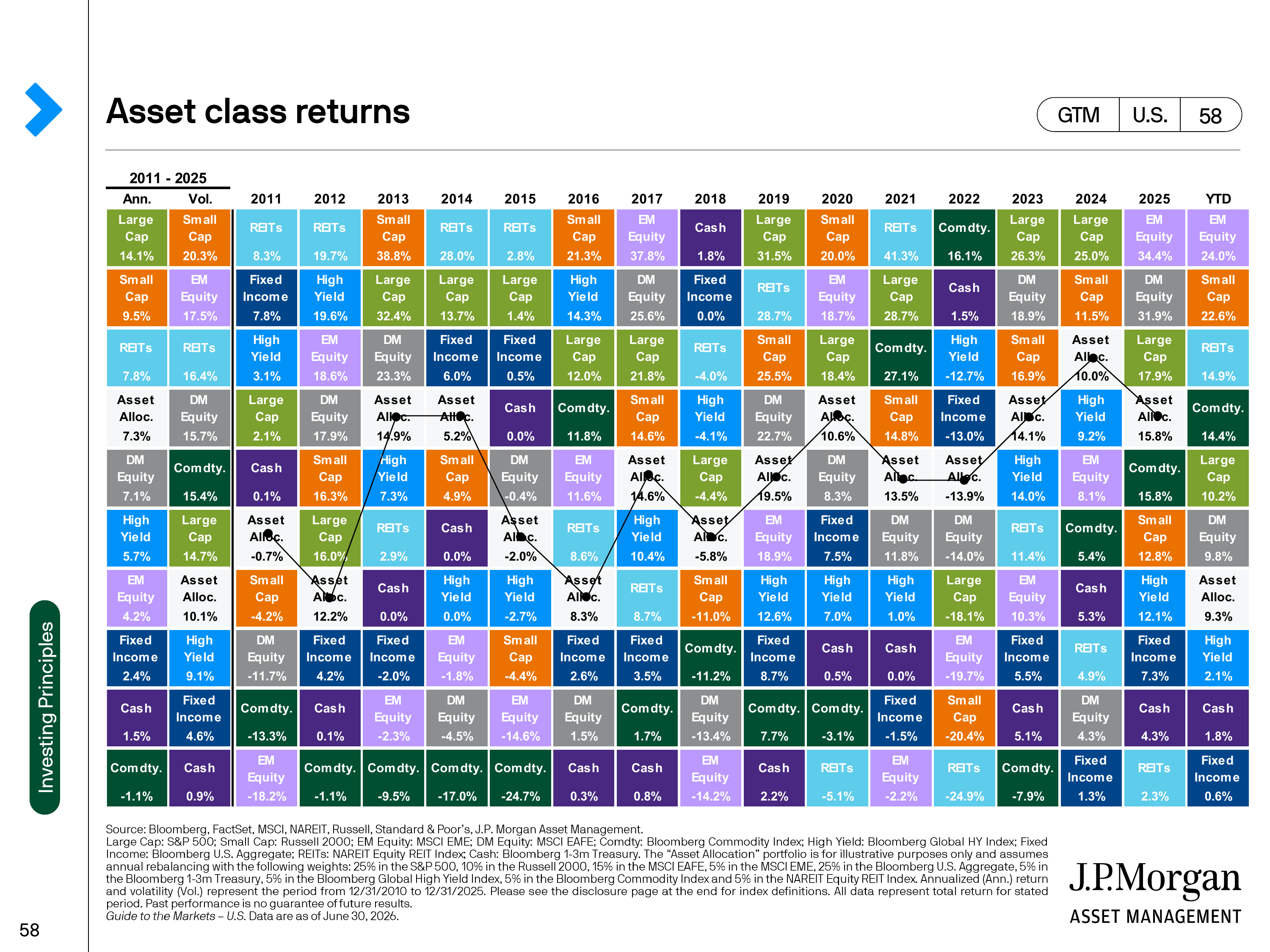
Source: J.P. Morgan Asset Management, Guide to the Markets - U.S., 'Asset class returns,' slide 58. Used for educational purposes. See chart footnotes for index definitions, weights and methodology.
The lack of a pattern is the lesson. REITs led in 2011 and 2012. Small-cap stocks led in 2013. Cash was the top performer in 2018. Large-cap U.S. stocks led in 2019 and 2023. Commodities led in 2022, and emerging-market equities led in 2025. The winner keeps changing, and we only know which asset class we should have owned more of after the year is over.
The diversified asset allocation mix shown in the chart tends to move through the middle while individual asset classes jump from top to bottom and back again. The diversified mix is not trying to win every year. It is constructed to reduce the portfolio's dependence on any single outcome.
If you judge a diversified portfolio against the single best-performing asset class each year, it will almost always disappoint you. But beating every asset class is not its job.
The Temptation to Fix What Is Lagging
This is where diversification becomes more difficult emotionally. Suppose one part of your portfolio gains 20% while another gains 5%. Even though both made money, it is hard not to wonder why you did not own more of the 20% investment. Stretch that gap over several years and the lagging investment can start to feel like a mistake. Selling it and moving the money into whatever has been working better can feel like an obvious improvement.
The problem is that repeated often enough, this can slowly turn a diversified portfolio into a concentrated one. It also asks recent performance to tell us what will happen next. The SEC's Investor.gov warns investors about behaviors such as focusing on past performance, following momentum, and failing to diversify adequately. Rebalancing can feel uncomfortable for the same reason: it may require trimming investments that have done well and adding to areas that have lagged in order to restore the portfolio's intended mix.
None of this means an investment deserves a permanent place in a portfolio simply because it adds diversification. Every holding should still have a reason for being there. Your goals can change. Your time horizon or cash-flow needs can change. An investment's costs or strategy can change. Those are valid reasons to revisit a portfolio. But 'something else performed better' is a different argument, especially when we only know the winner with the benefit of hindsight.
Today's Market Is a Real-Time Example
The current market shows how quickly the backdrop can change. Higher oil prices can benefit commodity-related investments while raising costs elsewhere in the economy. Higher Treasury yields can pressure existing bond prices and some stock valuations while improving the income available on newly issued bonds and cash. Geopolitical developments can affect countries, currencies, and industries differently. One headline can create several different market reactions.
Diversification does not mean one investment will always rise whenever another falls, either. Correlations change. In 2022, rapidly rising inflation and interest rates created a difficult environment for both stocks and bonds simultaneously. Diversification is not a guarantee against loss. It is a way to reduce reliance on a single outcome over time. That matters because we do not know which country, company size, sector, or asset class will lead next year, any more than we knew ahead of time what would dominate today's headlines.
The Psychological Cost of Diversification
Most explanations of diversification focus on risk and return. What gets less attention is the emotional cost: regret. You will see investments you do not own perform spectacularly. You will own something that is not keeping pace with the hottest part of the market. You may even watch someone with a concentrated portfolio earn much more for a period of time because they happened to be concentrated in exactly the right place.
That can make diversification feel like settling for less. But there is a difference between building a portfolio to maximize the return we wish we had earned and building one to support the financial life we are actually planning. Once we understand what the money is for, when it will be needed, and how much risk the plan can reasonably absorb, diversification becomes less about collecting investments and more about giving different parts of the portfolio different jobs.
Ask a Better Question
The next time one part of your portfolio disappoints you, the most useful question probably is not, Why didn't I own more of whatever performed best? A better question is: Does everything I own still have a reason for being here?
If an investment no longer supports your goals, no longer fits the amount of risk your plan can handle, or is not serving its intended purpose, it may deserve another look. But if its only offense is that another investment performed better recently, that alone may not mean something has gone wrong.
A diversified portfolio is not designed to make you love every investment you own at the same time. Leaders change, laggards change, and the diversified mix keeps moving through the middle. There will almost always be something you wish you had owned less of and something else you wish you had owned more of. The challenge, and much of the point of diversification, is building the portfolio before you know which one will be which.
Sources
- J.P. Morgan Asset Management. Guide to the Markets - U.S., Investing Principles, 'Asset class returns,' slide 58. Asset-class returns and hypothetical asset-allocation portfolio, 2011-2025.
- U.S. Securities and Exchange Commission, Investor.gov. 'Asset Allocation and Diversification'; 'Diversify Your Investments'; and 'Investor Bulletin: Behavioral Patterns of U.S. Investors.'
- Associated Press. Market coverage, September 2026. Reporting on U.S. equity markets, Treasury yields, oil prices, inflation concerns, and market volatility.